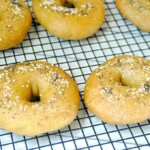
Bagels
Delicious Homemade bagels great for breakfast goes well with cream cheese of your choice.
Servings: 6
Calories: 292kcal
Ingredients
Dough
- 1 tablespoon 0.75 oz / 21 g barley malt syrup/ honey/ or rice syrup, or 1 teaspoon (0.25 oz / 7 g) diastatic malt powder
- 1 teaspoon 0.11 oz / 3 g instant yeast
- 1 ½ teaspoons 0.37 oz / 10.5 g salt, or 2 ½ teaspoons coarse kosher salt
- 1 cup plus 2 tablespoons 9 oz / 255 g lukewarm water (about 95°F or 35°C)
- 3 ½ cups 16 oz / 454 g unbleached bread flour
Poaching liquid
- 2 to 3 quarts 64 to 96 oz / 181 to 272 g water
- 1 ½ tablespoons 1 oz / 28.5 g barley malt syrup or honey (optional)
- 1 tablespoon 0.5 oz / 14 g baking soda
- 1 teaspoon 0.25 oz / 7 g salt, or 1 ½ teaspoons coarse kosher salt
Instructions
Day before baking
- To make the dough stir the malt syrup, yeast, and salt into the lukewarm water in a bowl.
- Place the flour into a mixing bowl and pour in the malt syrup mixture.
- coarse ball, and the flour should be fully hydrated; If using a mixer, use the dough hook and mix on the lowest speed for 3 minutes. If mixing by hand, use a large, sturdy spoon and stir for about 3 minutes, until well blended. The dough should form a stiff,
- Let the dough rest for 5 minutes.
- Resume mixing with the dough hook on the lowest speed for another 3 minutes or transfer to a very lightly floured work surface and knead by hand for about 3 minutes to smooth out the dough.
- Place the dough in a clean, lightly oiled bowl, cover the bowl tightly with plastic wrap, and let the dough rise at room temperature for 1 hour.
- When you’re ready to shape the bagels, prepare a sheet pan by lining it with parchment paper or a silicone mat, lightly coating it with oil.
- Divide the dough into 6 equal pieces. (A typical bagel is about 4 ounces or 113 grams before baking, but you can make them smaller.)
- Form each piece into a loose ball by rolling it on a clean, dry work surface with a cupped hand.
- (Don’t use any flour on the work surface. If the dough slides around and won’t ball up, wipe the surface with a damp paper towel and try again; the slight bit of moisture will provide enough traction for the dough to form into a ball.)
- Then poke a hole through the center of the ball to create a donut shape.
- Holding the dough with both thumbs in the hole, rotate the dough with your hands, gradually stretching it to create a hole about 2 inches in diameter.
- Place each shaped bagel on the prepared sheet pan, then mist with spray oil or brush with a light coating of oil. Cover the entire pan with plastic wrap and refrigerate overnight or for up to 2 days. (You can also proof the full piece of dough in the oiled bowl overnight and then shape the bagels on baking day, 60 to 90 minutes before boiling and baking them, or as soon as they pass the float test.)
On baking day
- Remove the bagels from the refrigerator 60 to 90 minutes before you plan to bake them,
- Immediately check whether the bagels are ready for baking using the “float test”: Place one of the bagels in a small bowl of cold water.
- If it sinks and doesn’t float back to the surface, shake it off, return it to the pan, and wait for another 15 to 20 minutes, then test it again. When one bagel passes the float test, they’re all ready to be boiled. If they pass the float test before you are ready to boil and bake them, return them to the refrigerator so they don’t over proof.
- About 30 minutes before baking, preheat the oven to 500°F (260°C) and gather and prepare your garnishes (seeds, onions, garlic, and so on).
- To make the poaching liquid, fill a pot with 2 to 3 quarts (181 to 272 g) of water, making sure the water is at least 4 inches deep. Cover, bring to a boil, then lower the heat to maintain at a simmer
- . Stir in the malt syrup, baking soda, and salt.
- Gently lower each bagel into the simmering poaching liquid, adding as many as will comfortably fit in the pot. They should all float to the surface within 15 seconds. After 1 minute, use a slotted spoon to turn each bagel over. Poach for another 30 to 60 seconds,
- on a generous amount of whatever toppings you like as soon as the bagels come out of the water then use the slotted spoon to transfer it back to the pan, domed side up. (It’s important that the parchment paper be lightly oiled, or the paper will glue itself to the dough as the bagels bake.) Sprinkle the top of bagels with seeds of your choice.I used black poppy seeds and sesame seeds
- Transfer the pan of bagels to the oven, then lower the oven heat to 450°F (232°C).
- Bake for 8 minutes, then rotate the pan and check the underside of the bagels. If they’re getting too dark, place another pan under the baking sheet. (Doubling the pan will insulate the first baking sheet.) Bake for another 8 to 12 minutes, until the bagels are a golden brown.
- Cool on a wire rack for at least 30 minutes before slicing or serving.
Notes
This recipe is adapted from here Peter Reinhart’s Artisan Bread Every Day
Nutrition
Calories: 292kcal | Carbohydrates: 60g | Protein: 9g | Fat: 1g | Saturated Fat: 0.2g | Polyunsaturated Fat: 1g | Monounsaturated Fat: 0.1g | Sodium: 1536mg | Potassium: 83mg | Fiber: 2g | Sugar: 7g | Vitamin A: 1IU | Vitamin C: 0.05mg | Calcium: 23mg | Iron: 1mg
Tried this recipe?Mention @nidhinikhil or tag #zestysouthindiankitchenrecipes!